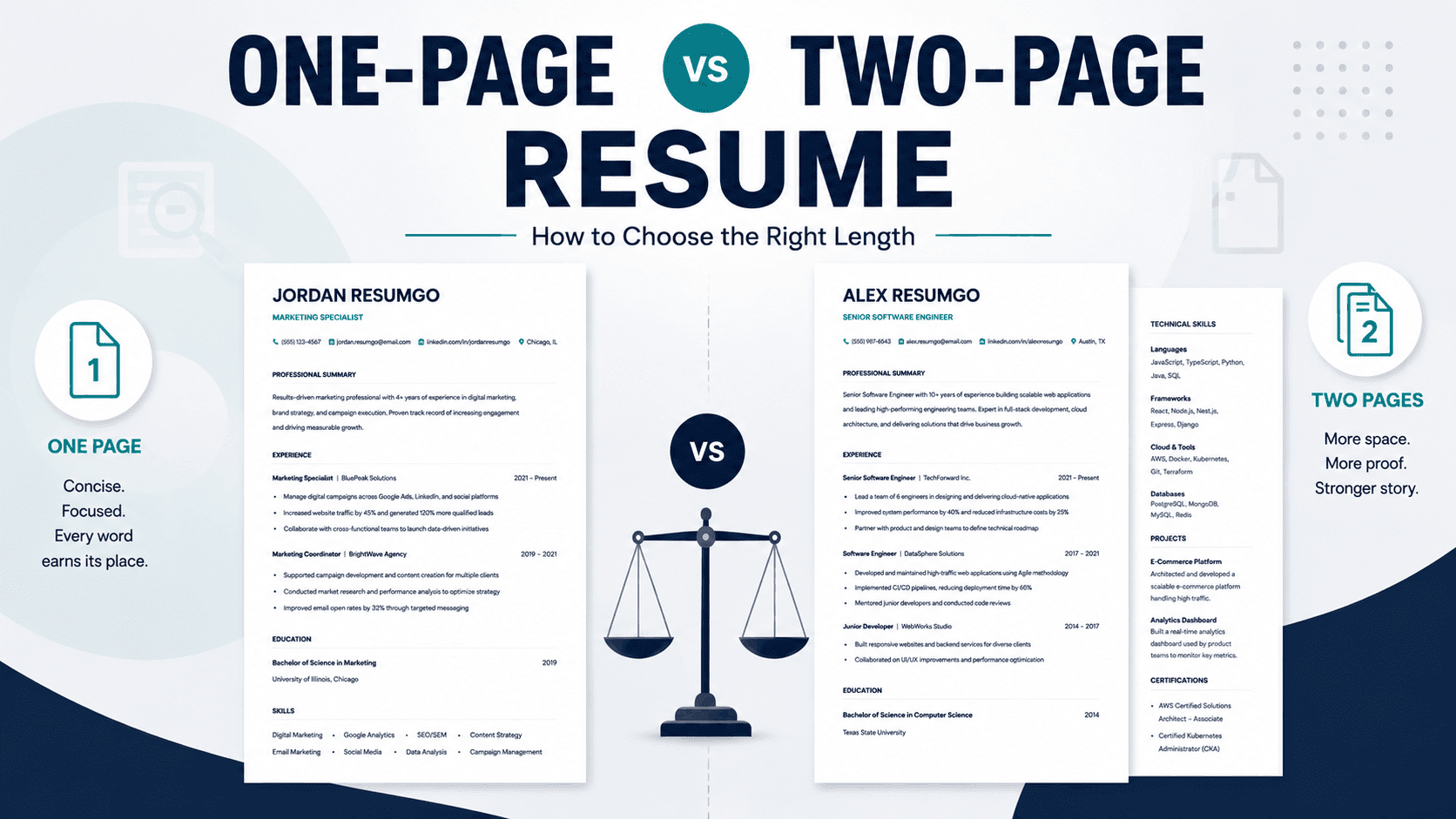
Quick summary
- One page is not a universal rule — it’s the right default for early-career professionals and career changers, not everyone
- The real question isn’t page count: it’s whether your second page earns its place with relevant proof
- Industry and role context matters — academia, government, and senior technical roles have different expectations
- Cramming or padding to hit a page target both backfire — length should follow content, not the other way around
The rule everyone follows — and why it was never the whole story
The one-page resume rule has been repeated so often it sounds like fact. It isn’t. It started as advice for a specific situation — entry-level candidates in high-volume hiring — and got applied to everyone. That’s where the damage happens.
Experienced professionals cut content that would have got them hired. New grads pad a single internship across two pages. Both are avoidable mistakes — and both come from treating page count as the goal rather than the outcome.
The Real Question
It’s not about page count — it’s about whether every line on your resume earns its place.
Experience Isn’t the Only Factor
Your industry, role type, and how you’re applying all affect the right choice.
Both Mistakes Are Common
Cramming onto one page and padding to fill two are equally damaging — here’s how to avoid both.
Quick overview
Jump to any section:
Where the One-Page Rule Actually Came From
The one-page resume rule is one of the most repeated pieces of career advice on the internet. It’s also one of the most misunderstood.
It didn’t emerge from some universal truth about hiring. It came from a specific context: entry-level job seekers in high-volume recruiting environments, where hiring managers spend seconds — not minutes — scanning each application. In that context, brevity is a genuine advantage.
Somewhere along the way, that contextual advice became a commandment. Career bloggers repeated it. College career centers enforced it. And now millions of experienced professionals are cramming 15 years of work history onto a single page, cutting the very details that would get them hired.
The one-page rule is useful. It’s just not universal. What actually matters isn’t page count — it’s whether every line on your resume earns its place, and whether your format makes it easy for a recruiter to see, in seconds, that you’re worth a closer look.
When One Page Is the Right Choice
For a lot of job seekers, one page genuinely is the right call. Not because of a rule — because of their situation.
Use one page if:
- You have fewer than 5 years of professional experience
- You’re a recent graduate, even with internships and projects
- You’re making a career change and your prior experience is only partially relevant
- You’re applying to high-volume roles — retail, hospitality, customer service — where screeners move fast
- You’re using your resume in a networking context, handing it to someone at an event or sending it via a warm introduction
In all of these cases, a tight one-pager signals that you know what’s relevant and you respect the reader’s time. It’s not a limitation — it’s a demonstration of judgment.
One more scenario worth mentioning: if you’re applying through a referral, a one-page resume often lands better. The person referring you is vouching for you. Your resume just needs to not undermine that endorsement. Brevity works in your favor.
When Two Pages Make Sense
Two pages is not a consolation prize for people who couldn’t edit. For the right candidate, it’s the correct format.
Use two pages if:
- You have 7 or more years of relevant experience
- You’re applying for a senior, technical, or managerial role with a detailed job description
- Cutting to one page would mean removing roles, projects, or achievements that directly support your candidacy
- You have significant technical depth — multiple programming languages, certifications, domain expertise — that needs space to be credible
- You’re applying for a role where your career progression itself is part of the story
That last point matters more than people realize. For senior hires, recruiters aren’t just evaluating your most recent job. They’re reading your trajectory — looking for consistent growth, increasing responsibility, a logical arc. A one-page resume for a director-level candidate can actually raise questions: what are they hiding? Why does their career look so thin?
A two-page resume packed with relevant proof beats a one-page resume that cuts the content that would have got you hired.
The key phrase is “relevant proof.” Two pages only works if both pages are doing real work.
What Belongs on Page Two (And What Doesn’t)
This is where most advice breaks down. Everyone says “use two pages if you have enough experience.” Nobody explains what “enough” actually means, or what should fill that second page.
Think of page one as your argument. Page two is your evidence.
What earns a place on page two:
- Additional relevant roles that show career progression or domain depth
- Significant projects with measurable outcomes
- Technical skills listed with enough specificity to be credible
- Relevant certifications, training, or continuing education
- Publications, presentations, or professional contributions — if directly relevant to the role
What doesn’t belong on page two:
- Jobs from more than 15 years ago, unless directly relevant to this role
- Generic skill lists (“Microsoft Office,” “team player,” “detail-oriented”)
- Hobbies or personal interests, unless you’re in a field where they’re genuinely relevant
- Anything you’d struggle to discuss confidently in an interview
- Padding — extra white space, oversized headers, or filler to “look” like two full pages
Industry and Role Exceptions
The one-page vs. two-page debate applies to standard professional resumes. Some fields operate by entirely different rules.
Academia: Academics don’t use resumes — they use CVs (curriculum vitae), which routinely run 5 to 10 pages. Research, publications, teaching experience, conference presentations, grants — all of it is expected and appropriate. Applying the one-page rule to an academic CV would be a serious mistake.
Government and federal roles: US federal applications on USAJobs now cap resumes at two pages as of September 2025. Previously, federal resumes were often 4 to 5 pages. If you’re applying for federal positions, two pages is both the maximum and the standard.
Tech roles: Many hiring managers at software companies — especially at startups — actively prefer a single clean page, even for experienced engineers. That said, senior engineers with deep specialization, patents, or open-source contributions often justify two pages.
Creative fields: In design, advertising, and creative industries, portfolio weight matters far more than resume length. A one-page resume with a strong portfolio link is almost always the right call. Your work speaks louder than your word count.
What ATS Actually Cares About
One of the most persistent myths around resume length is that two-page resumes get rejected by applicant tracking systems. This is not how ATS works.
Modern ATS platforms — Greenhouse, Workday, Lever, iCIMS — parse your resume for keyword relevance and structural clarity. They rank candidates; they don’t filter by page count. A two-page resume with clean formatting and strong keyword alignment will outperform a one-page resume with vague, generic content every time.
What ATS actually struggles with has nothing to do with length:
- Tables and multi-column layouts that break parsing
- Headers and footers where contact information gets lost
- Graphics, icons, or text boxes the parser can’t read
- Unusual fonts or design-heavy templates that confuse text extraction
ATS doesn’t count your pages. It reads your keywords, parses your structure, and ranks your relevance. Formatting is the real risk — not length.
The Practical Test: How to Decide Right Now
Forget the rules for a moment. Answer these three questions honestly.
1. Does everything on your resume directly support your candidacy for this specific role?
Go line by line. If you find bullet points that describe responsibilities rather than results, or roles that have no bearing on this job, those are candidates for cutting — not arguments for a second page.
2. Would cutting any of the remaining content leave out meaningful proof?
If trimming to one page means removing a role that shows relevant progression, or a project that demonstrates exactly what the job requires — then a second page is justified.
3. Does your layout breathe, or does it look compressed?
A resume with 10pt font, half-inch margins, and no white space is hard to read regardless of page count. If your one-page resume looks dense and claustrophobic, two clean pages will actually read better. Readability is not a luxury — it’s a function.
If questions 1 and 3 point to one page, stay there. If question 2 points to two, use two. The goal is always the same: make the strongest possible case in the most readable possible format. For well-structured starting points in both lengths, ResumGO’s professional resume templates and two-column resume templates are built to handle both formats cleanly.
Putting it all together
The one-page vs. two-page debate has consumed more energy than it deserves. The real question was always simpler: is every line on this resume earning its place? A tight, focused one-pager beats a padded two-pager in every hiring context. But a two-pager built from relevant proof — progressive roles, measurable outcomes, genuine technical depth — beats a cramped one-pager that cut the content a recruiter needed to see.
Length follows content. Decide what belongs on your resume first. Then see how many pages it takes to present it clearly. That number is your answer. If you’re starting from scratch or rebuilding for a specific role, ResumGO’s full template library includes formats optimized for both one-page and two-page resumes across every experience level.
Quick reference: one page vs. two pages by situation
| Situation | Recommended length | Why |
|---|---|---|
| Less than 5 years of experience | One page | Content doesn’t justify more; brevity signals focus |
| Recent graduate | One page | Even with internships and projects, one page is appropriate |
| Career changer | One page | Prior experience is partially relevant; prioritize what transfers |
| 5–7 years, single industry | One page (usually) | Tight one-pager still preferred unless roles are complex |
| 7+ years, progressive experience | Two pages | Career arc and depth of proof need space |
| Senior or director-level | Two pages | Recruiters expect to see trajectory, not just a snapshot |
| Technical role with deep specialization | Two pages | Skills, certifications, and projects require room to be credible |
| Academic or research position | CV (not resume) | Entirely different format and conventions apply |
| US federal government role | Two pages | USAJobs caps submissions at two pages (Sept 2025) |
| Creative or design field | One page + portfolio | Portfolio carries more weight than resume length |
Frequently asked questions
Should a resume be one page or two for entry-level?
One page. Entry-level candidates rarely have enough relevant professional experience to justify a second page. Instead of stretching to fill space, focus on making every line on your one-pager count — internships, projects, academic achievements, and skills relevant to the role. A concise, well-structured one-pager signals confidence and judgment.
Do hiring managers read page 2 of a resume?
For senior roles, yes — hiring managers actively look for career depth and progression, and page two gets read. For high-volume or entry-level screening, the first page carries most of the weight. The practical takeaway: put your strongest material on page one regardless of total length. Page two should reinforce a case that’s already compelling, not try to build one from scratch.
Is a two-page resume OK for someone with 5 years of experience?
Possibly. Five years sits in the gray zone. If your experience spans multiple relevant roles, significant projects, or technical depth that won’t fit cleanly on one page without compression, two pages is defensible. If you’re stretching a single job and a handful of skills to fill two pages, stay on one. The test is always the same: does the second page add proof, or does it add padding?
Does a two-page resume hurt your chances with ATS?
No. ATS systems rank resumes by keyword relevance and structural clarity — not page count. A well-formatted two-page resume with strong keyword alignment will perform better than a vague one-pager. The real ATS risks are formatting issues: tables, text boxes, multi-column layouts, and graphics that break parsing. Avoid those regardless of how many pages you use.
How long should a resume be?
For most professionals, one to two pages is the right range. One page works well for early-career candidates, recent graduates, and career changers. Two pages is appropriate for anyone with 7 or more years of relevant experience, senior or technical roles, or situations where cutting content would mean removing meaningful proof of qualifications. The right length is whichever lets you make the strongest case without padding or cramming.
Can a resume ever be three pages?
Rarely, for standard professional roles. Three pages is almost never appropriate unless you’re in academia (where a CV rather than resume is expected), applying for certain government positions, or you’re a senior executive with a genuinely complex career history. In most cases, if you’re at three pages, the answer is tighter editing — not a third page.


